

Why Web3 Super Apps Could Replace Wallets, Exchanges & dApps by 2030?
Web3 is powerful, but still confusing. Explore the possibilities of Web3 super apps, which could eliminate the need for wallets, exchanges, and dApps, making crypto as simple as Apple Pay by 2030.
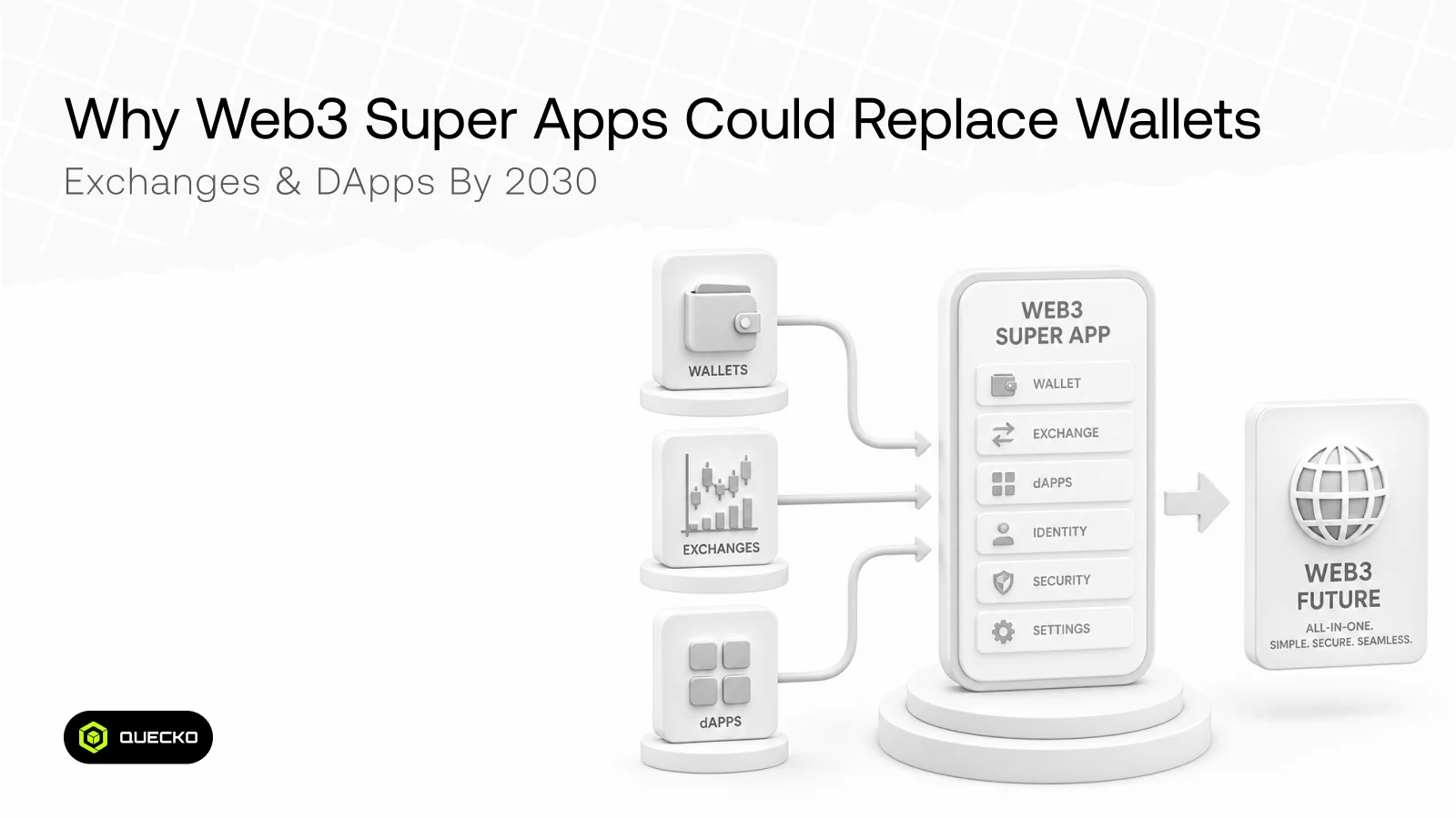
Before going deeper, let’s simplify what are web3 super Apps:
A Web3 super app is a single platform (super wallet app) where you can:
- store and manage digital assets
- trade without switching to a decentralized exchange
- access DeFi services
- explore NFTs
- manage crypto wallets
Instead of using 5 different apps, everything works in one place. Behind the scenes, this is all powered by an evolving wallet infrastructure that connects everything.
Think of it as Apple Pay, Binance and MetaMask combined into one seamless experience.
At the core of this system are user-controlled wallets and cryptocurrency wallets, ensuring users always stay in charge of their digital assets.
Why Web3 Still Feels Broken (Despite 400M Users)
Right now, over 400 million people are using crypto worldwide.
According to Statista, this number is expected to cross 600 million by 2030, but there’s a problem:
The experience hasn’t caught up with adoption. Geographic trends also show that adoption is growing faster in certain regions compared to others.
Today, users still:
- Jump between web3 wallets
- Use separate platforms for DeFi services
- Rely on different decentralized applications
- Manage digital assets across multiple interfaces
Getting started often requires using fiat on-ramps, which adds another layer of complexity for new users. Even basic things like handling private keys or tracking assets feel overwhelming. Most users still rely on multiple cryptocurrency wallets, which adds unnecessary complexity.
And when compared to something like Apple Pay… the gap is obvious. Even modern payment technologies haven’t fully simplified how users move between fiat and crypto systems, partly because legacy systems still dominate the financial rails.
What Real Users Are Saying (Reddit Signals)
This isn’t just theory, it’s how users actually feel.
I need one app for my wallet, another for trading, and another for NFTs; it’s exhausting.
Crypto feels like juggling five apps just to do one thing.
That frustration is exactly why Web3 super apps are gaining momentum.
The Real Problem: Fragmentation
Web3 today looks like this:
| Task | Tool |
| Store crypto | web3 wallets |
| Trade tokens | decentralized exchange |
| Earn yield | DeFi services |
| NFTs | Separate platforms |
Nothing connects smoothly.
This fragmentation is the biggest barrier to mass adoption. This also highlights how fragmented the current wallet ecosystem still is.
Why Are Web3 Super Apps Inevitable?
Super apps solve one core problem:
They remove friction. A big reason is possible today is because of Layer 2 improvements, making everything faster and cheaper.
Instead of switching apps, users can:
- manage digital assets in one place
- trade instantly
- access DeFi services
- monitor portfolios
- super wallet apps
- Even simple UX elements like QR codes are becoming part of seamless Web3 interactions.
- easy portfolio management without jumping between different dashboards
Even emerging use cases like prediction markets can be integrated directly into a single super app experience, removing the need for separate platforms. Simple actions like token swaps become much easier when everything is in one place. It’s not new technology, it’s a better experience.
How Web3 Super Apps Actually Work?
This is where your blog was slightly weak, so here’s a strong addition:
1. Smart Contracts Power Everything
They automate:
- staking
- lending
- automated trading
- asset management
Some platforms also use smart routing to automatically find the most efficient way to execute trades. Most of Web3 already runs on this backend. As Web3 grows, smart contracts will quietly handle more complex actions in the background, making the experience smoother for everyday users.
Behind the scenes, liquidity channels help ensure trades and transactions happen smoothly without delays. A lot of this efficiency comes from smart contract automation working in the background. Some platforms are already experimenting with AI advice to help users make smarter decisions inside Web3 apps, often delivered through developer-friendly React Native SDKs and even guiding users through exchange listings when new tokens launch.
2. Account Abstraction Simplifies UX
This removes the complexity of crypto wallets.
Users don’t need to:
- manage seed phrases manually
- worry about technical steps
This shift is also driven by smart wallet innovation, making wallets feel less technical and more like everyday apps. It makes crypto feel like a normal app, especially when paired with React Native SDKs that simplify mobile integration and are supported by Ethereum’s EIP-7702, pushing account abstraction forward.
3. Cross-Chain Infrastructure
Super apps connect multiple blockchains. That is precisely when cross-chain interoperability becomes essential in ensuring the assets move flawlessly from one chain to another. Apart from that, it also facilitates a significant step towards deeper integration of native BTC in the multi-chain ecosystems.
That means:
- digital assets move freely
- No need for multiple wallets
- smoother user experience
This kind of multi-chain connection is exactly why the entire experience seems invisible (and therefore, effortless) to the user. Cross-chain bridges play a crucial role in the sequence of events that bring about fully seamless asset transfers between various blockchain networks.
4. Layer 2 Scaling Makes It Usable
Without Layer 2:
- Fees stay high
- transactions stay slow
With it:
- faster transactions
- lower costs
- scalable ecosystem
This is why Layer 2 solutions are becoming a core part of how modern Web3 apps are being built, and this also makes super apps practical.
Web3 Today vs Web3 Super Apps (2030 Vision)
| Today | With Super Apps |
| Multiple apps | One unified platform |
| Complex UX | Simple interface |
| Fragmented assets | Unified digital assets view |
| Manual processes | Automated actions |
Beyond Finance: Real-World Use Cases
This is where things get interesting.
Super apps won’t just be about trading.
They will enable:
- tokenized real estate. This opens the door for easier access to real estate investments without traditional barriers.
- ownership of on-chain assets, global investment access
- Users can also explore NFT marketplaces directly within the same app and even integrate loyalty program membership cards directly into the same ecosystem.
This is one of the ways Web3 penetrates the physical world. For example, Mantra Chain is one of the projects that has started studying the integration of real-world assets into Web3 ecosystems. Besides, this change is enabling digital commerce to have new strategies, where users will be able to communicate, trade, and invest without depending on traditional platforms. We’re also seeing integration with POS systems, bringing Web3 closer to real-world retail use cases.
We’re also starting to see prediction markets gaining attention as part of broader Web3 engagement models beyond just trading. We may also see loyalty programs integrated directly into these apps, and for everyday users, these super wallet apps could feel like the natural bridge between crypto and real-world payments, simple, familiar, and seamless.
DeFi Inside Super Apps (All-in-One)
Instead of switching platforms, users get:
- staking
- lending
- swaps
- yield farming
- token swaps
- full DeFi services
All integrated into one interface. Some platforms are also introducing liquidity staking, giving users more flexibility while earning rewards. These even support automated trading, so users don’t need to constantly monitor the market.
Security Still Matters
Even with better UX:
- Users still control private keys.
- Crypto wallets are evolving.
- Recovery systems are improving.
New features include:
- social recovery
- multi-layer authentication
- identity systems
This is also improving with Web3 authentication, allowing users to securely log in without relying on traditional passwords. Advanced cryptographic methods like multi-party computation are also being explored to improve privacy while keeping systems secure.
In some cases, light identity verification is also being introduced to add an extra layer of protection, often working alongside payment service providers to bridge fiat and crypto securely. This is where digital identity plays a key role in helping users securely access and recover their accounts.
Will Web3 Super Apps Replace Wallets & Exchanges?
Short answer: Yes, but do not completely remove them.
Instead:
- Web3 wallets become part of the system
- decentralized exchange functionality is built-in
- decentralized applications run in the background
Users won’t notice them; they’ll just use the app, with decentralized exchange functionality built in and exchange listings integrated directly into the interface to make token discovery seamless.
Challenges You Can’t Ignore
To keep it realistic (important for credibility):
- centralization risks
- regulatory frameworks
- security at scale
As adoption grows, regulatory requirements like a VASP license may become more common for platforms operating globally. The challenge is balancing simplicity + decentralization.
At the same time, many platforms must still integrate with legacy systems, which slows down innovation and makes the transition to super apps more complex. Industry voices like Mats Olsen have pointed out that solving this balance will define whether super apps truly scale worldwide.
What Happens by 2030?
With Layer 2 continuing to improve, this shift toward simpler apps will only accelerate.
We’re moving toward a future where:
- You don’t need multiple crypto wallets (super wallet apps)
- Digital assets are managed in one place.
- DeFi services are accessible instantly
- apps feel invisible
- loyalty programs and rewards become part of everyday app usage
Web3 becomes usable, not just powerful.
How Quecko Reflects the Shift Toward Web3 Super Apps?
As Web3 moves toward simpler, all-in-one experiences, platforms like Quecko are already working in that direction, just in a more practical, behind-the-scenes way.
Right now, Web3 still feels scattered. Different tools, different apps, different steps. But if you look closely, the foundation for super apps is already being built.
Quecko, for example, isn’t focused on just one feature. It’s involved in building things like DeFi platforms, NFT marketplaces, and cross-chain solutions, basically the same pieces that a future super app would bring together in one place.
That’s what makes this interesting.
Instead of trying to create a “super app” overnight, the approach is more realistic; build strong, connected systems first, and let the experience naturally become simpler over time.
Because in the end, users don’t care about the complexity behind the scenes.
They just want things to work smoothly, securely, and in one place.
And that’s exactly the direction Web3 is moving in.
Conclusion
Web3 isn’t just evolving, it’s becoming usable, and that’s a big step forward for blockchain technology.
Behind the scenes, smart contracts will continue to power everything, even if users never directly interact with them, and that’s what drives real adoption. In the future, smart contract automation will quietly power most of the user experience.
If super apps can successfully combine web3 wallets, trading, DeFi services, and asset management into one seamless experience, it changes everything.
Instead of complexity, users get simplicity.
Instead of fragmentation, they flow.
As futurist Kevin Kelly often reminds us, technology’s true power lies in making the complex feel invisible. Web3 super apps are exactly that, turning blockchain’s hidden machinery into everyday simplicity.
FAQs
1: Will Web3 super apps replace Web3 wallets?
Not exactly replacements, but they’ll make things much easier. Managing multiple wallets will be a thing of the past, as all your operations will be done inside one app. You’ll still keep control of your assets, but there will be no switching and confusion at all.
2: Why are Web3 super apps getting so popular?
Because people are tired of using 4–5 apps just to do basic things. Super apps bring everything, trading, NFTs, DeFi, into one place, which makes the whole experience smoother and less stressful.
3: Are Web3 super apps safe to use?
They’re becoming safer with features like social recovery and better security layers. But like anything in crypto, it still depends on the platform you’re using and how careful you are.
4: Can I use DeFi in a Web3 super app?
Indeed, that is one of the biggest reasons to do it. You can stake, lend, swap, and explore DeFi without jumping between different platforms.
5: What’s the biggest benefit of Web3 super apps?
Everything is together in one place, your assets, trades, and apps, so you won’t have to constantly switch or figure out things each time overhead.
6. What makes Quecko different from other Web3 platforms?
Quecko focuses on making Web3 easier to understand and use, instead of just adding more features. While many platforms feel complex, the idea here is to simplify how users explore things like DeFi, NFTs, and market trends, all in a more connected way.
Author

Khola Abbasi
No description availableDate
20 days agoShare on
Related Blogs
MetaMask Alone Is Not Enough: Why dApps Need WalletConnect Too
11 days ago
The Technology Cold War : How the US-China Split Is Creating Two Parallel Internets
12 days ago

Web3 Marketing Costs in 2026: What Crypto Startups Should Expect
15 days ago
Why Web3 Super Apps Could Replace Wallets, Exchanges & dApps by 2030?
20 days ago








 +971-50-740-0268