

MetaMask Alone Is Not Enough: Why dApps Need WalletConnect Too
Discover why top Web3 apps use WalletConnect with MetaMask to improve wallet access, onboarding, and mobile UX.
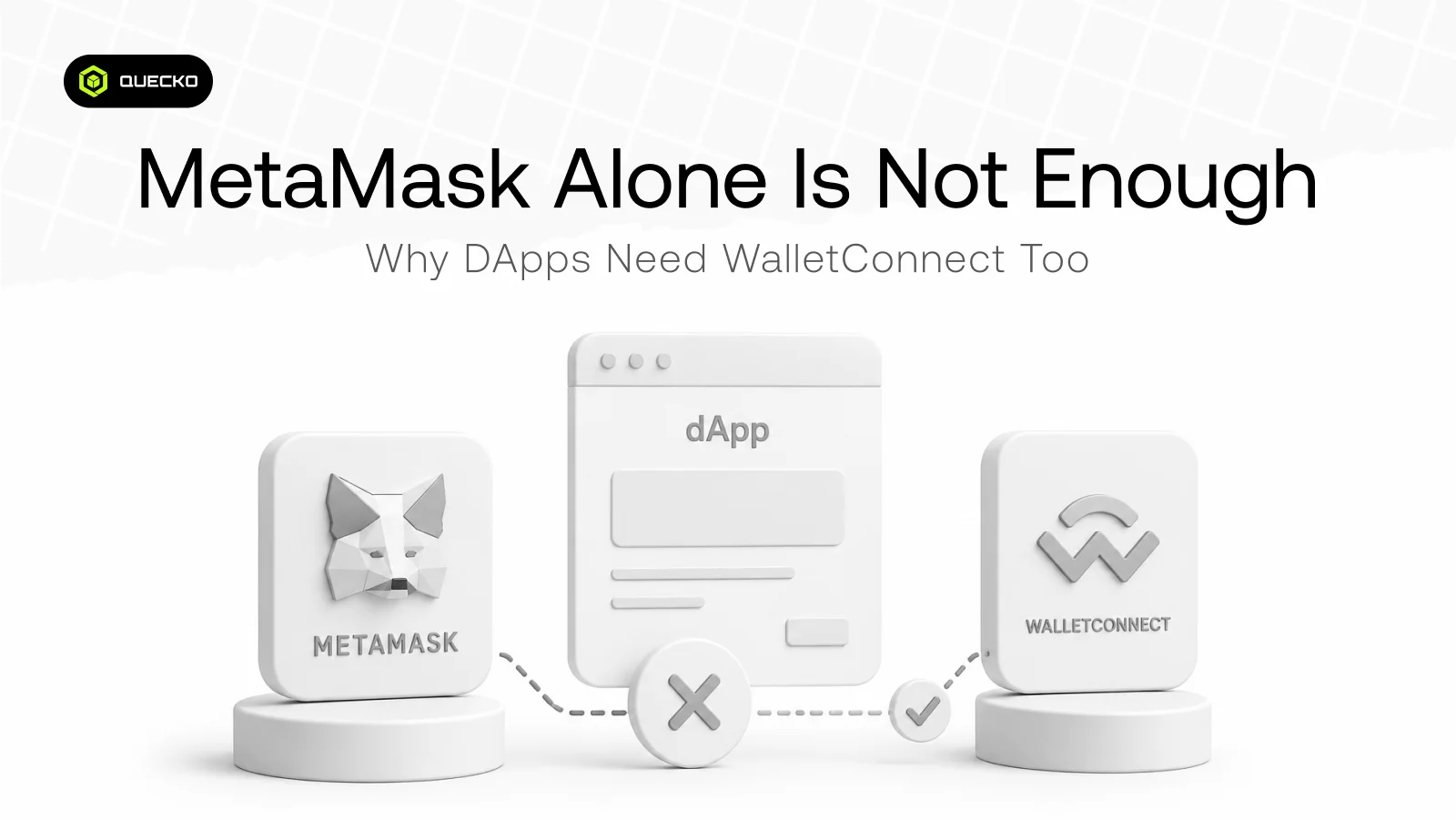
However, a few years ago, most Decentralized Applications were only required to have the MetaMask browser extension for wallet connections. The user would connect their wallet via the MetaMask Wallet, approve the smart contract, pay gas fees, and then start using the application.
That approach worked when most Web3 users interacted from desktop devices.
But Web3 has changed quickly.
Today, users discover dApps through smartphones, switch between devices constantly, and expect onboarding to feel simple. Many users now prefer the MetaMask mobile app, while others opt for hardware digital wallet solutions for enhanced protection of their private keys. Some advanced setups even interact through Web3 API Wallet integrations to enable automated blockchain interactions.
The transition is transforming the way modern dApps manage wallet onboarding procedures.
According to Statista, there is an increasing trend towards mobile-first crypto adoption, as well as a rise in real-life applications in developing countries based on wallets, according to Chainalysis. The Dune Analytics report also points to an increasing trend in on-chain transactions for both EVM and Layer 2 networks, particularly within the DeFi sector and cross-chain interoperability.
Nonetheless, there is still some discontent expressed on Reddit: “I wanted to use the application, but the process of linking my wallet was confusing.”
That problem matters more than many projects realize.
In 2026, users will still expect the onboarding process to be quicker, smart contract approval workflows to be more intuitive, gas fees disclosure to be easier, and the user experience to be consistent across different devices. It is understood from here why WalletConnect, MetaMask Connect, and Web3 API Wallet are quickly becoming the fundamental parts of the modern Web3 ecosystem.
Why Do Modern dApps Need More Than One Wallet Connection Option?
Why should users depend on a single wallet setup?
They should not.
Modern users interact with decentralized applications differently. Some use the MetaMask mobile app daily, while others prefer crypto wallets connected to a hardware digital wallet for stronger security. Advanced users also rely on Web3 API Wallet integrations to automate interactions with smart contracts.
Institutional teams are also entering blockchain markets through MetaMask Institutional solutions that support governance and treasury management.
This is why MetaMask Connect has become so important.
Instead of forcing users into one onboarding flow, developers can support:
- desktop users
- mobile-first users
- institutional teams
- multi-chain participants using Web3 API Wallet systems
- automated DeFi bots powered by Web3 API Wallet infrastructure
Several developers on Reddit mention that relying only on the MetaMask browser extension creates onboarding friction for mobile users. Many users leave dApps completely after failed wallet pairing or confusing gas fee approvals.
In Web3, the onboarding experience directly affects retention.
How WalletConnect Improves the User Experience?
WalletConnect is popular because it offers a solution to a Web3 challenge of connecting mobile wallets.
WalletConnect is more than a browser extension. It helps users to link crypto wallets simply by scanning QR codes or by deep linking.
The experience is so subtle that you hardly notice those transitions.
For example, users can browse a dApp on a desktop and instantly connect through the MetaMask mobile app without restarting the session.
This creates:
- faster onboarding
- better accessibility
- lower friction
- Improved wallet continuity, powered by Web3 API, Wallet compatibility
Multichain support is another capability that WalletConnect provides for users to navigate between blockchain networks.
With many dApps becoming increasingly mobile-oriented, collaboration efforts have begun among MetaMask Connect, Web3 API Wallet, and WalletConnect to enhance their onboarding processes.
These findings collectively indicate an evident trend towards more mobile, interactive, and infrastructural approaches to Web3 adoption.
The Limits of the MetaMask Browser Extension
The MetaMask browser extension still remains one of the most important tools in Web3.
It introduced millions of users to decentralized finance and blockchain applications.
But user behavior has evolved.
Many users now enter Web3 through mobile devices first. Asking them to install a desktop extension before interacting with a dApp creates unnecessary friction.
This is where MetaMask SDK becomes valuable.
The MetaMask SDK helps developers create better onboarding experiences across desktop and mobile environments. Combined with MetaMask Connect, it allows smoother wallet pairing without forcing users into a desktop-only workflow.
Some modern systems even integrate Web3 API Wallet layers to reduce direct wallet interactions altogether.
The MetaMask SDK is especially useful for projects focused on accessibility and mobile-first onboarding.
Web3 onboarding is not only about connectivity.
It is also about trust.
Why Wallet Security Still Confuses Users?
Many new users still struggle to understand:
- private keys
- seed phrase recovery
- smart contract approvals
- gas fee prompts
One mistake can permanently expose assets.
Some hardware setups like OneKey Perpsis are increasingly used alongside MetaMask Wallet solutions to improve private key security.
This is why wallet education matters.
Developers should clearly explain:
- How do private keys work?
- Why is a seed phrase shared?
- How do smart contract permissions function?
- Why does gas fee transparency improve trust?
- How do Web3 API Wallet interactions automate transaction flows?
Many Redditers confess they abort transactions mainly because they do not understand the content of what they are approving.
Such a misunderstanding affects onboarding significantly, even more than most projects estimate.
Why MetaMask Connect Is Becoming Essential?
Modern users expect wallet onboarding to feel simple across every device.
They want:
- mobile compatibility
- fast wallet pairing
- smoother smart contract approvals
- fewer interruptions during transactions
MetaMask Connect helps create that experience.
A user may start interacting with a dApp on a desktop and continue later through the MetaMask mobile app without reconnecting repeatedly.
That flexibility improves retention significantly.
Some advanced ecosystems also use Web3 API Wallet systems to maintain session continuity without repeated wallet approvals.
As blockchain adoption grows across the fintech industry, smoother onboarding is becoming one of the biggest competitive advantages for dApps.
How MetaMask Institutional Is Expanding Enterprise Web3 Adoption?
Web3 is no longer limited to retail users.
Large organizations are now exploring blockchain infrastructure for payments, treasury management, and tokenized assets.
This is where MetaMask Institutional is becoming increasingly important.
MetaMask Institutional provides:
- governance controls
- enterprise permissions
- secure approvals
- treasury infrastructure
Many enterprise systems now combine MetaMask Institutional with multi-party computation solutions to improve wallet security.
Some organizations also use OneKey Perpis and hardware digital wallet setups for additional protection of private keys.
As institutional blockchain adoption grows inside the financial sector, enterprise wallet infrastructure will become even more important.
MetaMask Institutional is helping lead that transition.
Why Are Embedded Wallets Growing?
Still, many users find Web3 onboarding too technical.
Terms like seed phrase, gas fee, and smart contract approval often feel overwhelming for beginners.
This explains the rise in popularity of embedded wallets.
Embedded wallets simplify onboarding by allowing users to access dApps without complicated wallet installation processes.
Many projects now combine:
- MetaMask Connect
- WalletConnect
- embedded wallets
- Hardware digital wallet support
- Web3 API Wallet layers for seamless blockchain access
to create more flexible onboarding systems.
This multi-level strategy not only makes things more accessible but also makes onboarding less of a hassle.
How Artificial Intelligence Is Changing Wallet UX?
Artificial intelligence is starting to influence wallet onboarding, too.
Some dApps now use AI-powered systems to:
- explain gas fee prompts
- simplify wallet setup
- Identify risky smart contract approvals
- guide users during onboarding
This matters because confidence remains one of Web3’s biggest barriers.
When users feel confused, they leave.
Projects that simplify onboarding psychologically, not just technically, will likely retain users more effectively.
Why Are Developers Combining Multiple Integration Options?
Modern dApps no longer rely on one onboarding method.
Instead, they combine multiple integration options to support different user preferences.
A modern wallet setup may include:
- MetaMask Connect
- WalletConnect
- MetaMask mobile app support
- hardware digital wallet compatibility
- embedded wallets
- MetaMask Institutional infrastructure
This improves:
- accessibility
- onboarding speed
- retention
- mobile usability
Most users do not care which protocol powers the wallet flow.
They only notice when onboarding feels difficult.
Quecko: Powering Secure Wallet Integration and Next-Gen dApp Infrastructure in Web3
Quecko focuses on building practical blockchain systems that make Web3 applications easier to use, more secure, and scalable for real users.
At the foundation level, it works with Hierarchical Deterministic wallet structures that help users manage and recover wallets more safely across different applications.
Quecko is specifically designed for today’s blockchains, such as the Ethereum Virtual Machine, ensuring cross-compatibility in smart contract ecosystems while providing a platform for scalability in application design in networks like Linea Mainnet.
To simplify onboarding, Quecko also explores Native Integration Mode, which reduces friction by allowing wallets to connect more smoothly inside applications.
The strategy employed by Quecko for designing the infrastructure behind dApps centres on boosting performance and improving the user experience.
Security remains a priority, especially through hardware-wallet signing, which keeps transaction approvals protected on secure devices rather than exposed environments.
This is important in reducing risks like stolen assets, which often happen due to poor security practices or unsafe contract interactions.
Conclusion
The MetaMask browser extension still plays a major role in Web3, but modern users expect more flexibility than before.
They want smoother onboarding across desktop and mobile devices, easier smart contract approvals, and better wallet accessibility.
That is why MetaMask Connect and WalletConnect are becoming essential for modern dApps.
At the same time, innovations like Web3 API Wallet systems, Ethereum Improvement Proposals, and PoS networks are shaping how blockchain applications interact with users and infrastructure. Tools like OneKey Perpsis are also strengthening private key security across ecosystems.
Projects that improve wallet onboarding will likely see stronger retention, better engagement, and long-term growth as blockchain adoption expands across the fintech industry and financial sector.
Because in the end, users remember one thing most:
How easy the experience felt.
FAQs
1. Which service provides seamless multi-device wallet connections for dApps?
WalletConnect is widely used for secure multi-device wallet connectivity between mobile wallets and desktop decentralized applications.
2. Why do decentralized apps need multiple wallet connection options?
Different users prefer different crypto wallets and devices. Supporting multiple onboarding methods improves accessibility and retention.
3. How can integrating multiple wallet protocols improve user experience in decentralized apps?
Using MetaMask Connect and WalletConnect helps reduce onboarding friction, improve mobile compatibility, and simplify wallet accessibility.
4. What is the best way to connect mobile wallets to desktop decentralized applications?
WalletConnect lets users link their wallets by scanning a QR code or through deep linking, making it easier for them to get on board across different devices.
5. How does Quecko improve dApp development and wallet security?
Quecko supports dApp developers by creating a robust infrastructure that is capable of handling the latest wallet systems, ensuring safety during transactions, and being compatible with multiple chains. It not only brings next-generation wallet models and transaction signing methods but also makes onboarding so seamless that users have fewer reasons to drop off. Besides, it contributes to the overall user safety enhancement in Web3 applications.
Author

Khola Abbasi
No description availableDate
4 days agoShare on
Related Blogs
MetaMask Alone Is Not Enough: Why dApps Need WalletConnect Too
4 days ago
The Technology Cold War : How the US-China Split Is Creating Two Parallel Internets
5 days ago
Web3 Marketing Costs in 2026: What Crypto Startups Should Expect
8 days ago
Why Web3 Super Apps Could Replace Wallets, Exchanges & dApps by 2030?
13 days ago







 +971-50-740-0268