

Stablecoins Are Eating PayPal’s Lunch — Here’s the Data
Stablecoins processed $33T in 2025 vs PayPal’s $1.68T. Here’s what the data says about who controls the future of payments.
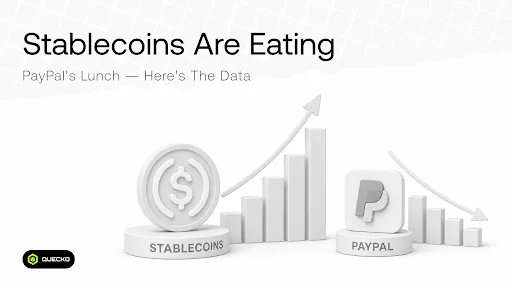
In 2024 Paypal processed $1.68 trillion in total payment volume, and then in that same year stablecoins moved $27.6 trillion. Those numbers aren’t even close to being in the same league.
The numbers became even more lopsided in 2025 when Stablecoin transaction volume hit $33 trillion, almost 20 times what PayPal processed. Monthly volumes peaked at $969.9 billion in just August 2025 alone, PayPal’s best quarter that year was around $437 billion.
This is not a crypto story anymore. It is a payments infrastructure story. Stablecoins are pegged digital currencies, usually to the US dollar, that settle in seconds and cost fractions of a cent to send. They do not speculate. They do not swing 30% overnight. They move money.
This piece breaks down the data head-to-head, looks at where stablecoin payments are actually being used, examines what the GENIUS Act means for the competitive landscape, and explains why PayPal itself is quietly trying to join the network it is losing ground to.
The Volume Gap, by the Numbers
The headline comparison is stark, but it needs context. Stablecoin volume figures include high-frequency financial flows, DeFi activity, and institutional settlement, not just consumer payments. Up to 70% of 2024 stablecoin volume was attributed to bot or automated activity.
So researchers apply an “adjusted” filter. Even on that basis, the gap does not close.
Adjusted stablecoin transaction volume grew 91% to $10.9 trillion in 2025, according to Bessemer Venture Partners. That still puts stablecoins at roughly six times PayPal’s annual volume. Real-world stablecoin payments, which include actual commerce, payroll, and remittances, had doubled back in 2025 to $400 billion. 60% of that is estimated to be B2B transactions alone.
| Metric | Stablecoins (2024) | Stablecoins (2025) | PayPal (2024) |
| Total transaction volume | $27.6T | $33T | $1.68T |
| Adjusted / real-world volume | ~$9T | ~$10.9T | $1.68T |
| Market cap / asset base | ~$205B | ~$306B | $68B market cap |
| YoY volume growth | +106% | +72% | +10% |
| Monthly peak volume | $1.25T (Sept 2025) | $969.9B (Aug 2025) | ~$437B (Q4 2024) |
Sources: A16z State of Crypto 2025 | Bessemer Venture Partners | PayPal FY2024 | Plasma.to
Where the Money Is Actually Moving
The volume figures matter. But the use cases matter more. Stablecoin adoption is not uniform. It is concentrated in three specific areas where traditional payment rails fail.
a) Cross-border remittances:
You’d need to pay an average of 6% in fees, and on top of that wait 1 to 3 days just to send 200$ via Western Union or MoneyGram. Meanwhile a USDT transfer on Tron costs less than 1$ and settles in only seconds. For the estimated 281 million migrant workers globally, that gap is not abstract. It is money that either reaches family or does not.
b) B2B payments:
Businesses that are operating across borders have actively started to settle their invoices in USDC instead of waiting long periods for SWIFT wires to clear. This has led to Stablecoin-based B2B payments surging from below $100 million monthly in early 2023 to over $6 billion by mid-2025.
c) Emerging market savings:
In high-inflation economies like Argentina, Turkey, and Nigeria, USDT has become a practical savings account. Users hold dollar-pegged assets to preserve value, not to speculate. Over 161 million people worldwide now hold stablecoins, a figure that exceeds PayPal’s 434 million active accounts only when you account for the fact that many stablecoin holders have no access to PayPal at all.
The GENIUS Act: What It Changes
For most of stablecoins’ history, the lack of US federal regulation was both a feature and a liability. It enabled permissionless growth but kept institutional capital cautious.
All of that changed when President Trump signed something known as the GENIUS Act into law on July 18, 2025. This is the first comprehensive federal framework in the United States that exists for Stablecoins. Key provisions:
- Mandatory 1:1 reserve backing in liquid assets such as Treasury bills and bank deposits
- Monthly attestation requirements for large issuers
- A dual federal and state licensing system
- Prohibition on issuers paying yield directly to holders
The Federal Reserve noted that Ethereum stablecoin transaction volumes rose 50% after the GENIUS Act was signed, as institutional confidence increased. Circle, Ripple, Paxos, and BitGo all received provisional banking charters from the OCC.
The regulatory clarity also created a competitive opening. With banks now permitted to issue their own stablecoins, Citigroup CEO Jane Fraser confirmed the bank is considering launching one. JPMorgan and Bank of America have filed for licenses. The stablecoin market is no longer a crypto-native space. It is becoming a banking battlefield.
PayPal’s Response: If You Can’t Beat Them
PayPal took note of this shift in 2023 and proceeded to launch PYUSD, which was its own dollar-pegged stablecoin. By late 2025, it had topped $1 billion in circulation after it expanded to Tron and Avalanche networks. On top of that it also had a 3.7% rewards program attracting retail holders.
It is a meaningful move. But PYUSD’s $1 billion market cap sits against USDT’s $161 billion and USDC’s $65 billion. PayPal is building on the same rails it is losing payment volume to.
The deeper issue is structural. PayPal’s model relies on:
- Merchant and consumer fees (typically 2.9% + $0.30 per transaction)
- Holding user balances and generating interest income
- Cross-border transfer fees
Stablecoin rails charge fractions of a cent, settle in seconds, and require no intermediary. For every use case where stablecoins are cheaper and faster, PayPal loses a reason to exist. The company’s take rate has declined by an average of 4.76% per year over the past five years, and the pressure is not easing.
The Risks That Are Real
The stablecoin growth story has genuine counterarguments. They deserve honest acknowledgment.
S&P Global downgraded Tether’s USDT stability to “weak” in November 2025, citing Bitcoin holdings in its reserves as a vulnerability. Tether has faced reserve transparency concerns for years, and a full third-party audit by a Big Four firm remains incomplete.
The GENIUS Act’s yield prohibition also creates friction. Products that previously paid stablecoin holders directly cannot do so under the new framework, which may slow retail adoption in markets where yield was the primary incentive.
And the volume comparison has limits. Stablecoin transaction data includes intra-protocol loops, liquidations, and automated flows that have no equivalent in PayPal’s consumer payment volume. To compare them directly without any adjustment would overstate the displacement.
Final Thoughts
If you were to take this at face value, the headline comparing $33 trillion vs $1.68 trillion creates more heat than light. But even the adjusted figures show how clearly Stablecoins are building payment infrastructure that not only operates faster, but cheaper, and more globally than anything PayPal has ever built in 25 years.
What’s even more interesting than the volume gap is the trajectory. PayPal’s payment volume grew 10% in 2024. Adjusted stablecoin volume grew 91%. The gap does not need to be absolute to be decisive. It just needs to keep widening in the use cases that matter: remittances, B2B settlement, and emerging market access.
PayPal launching PYUSD tells you what the company thinks is coming. Watch whether the GENIUS Act framework accelerates institutional stablecoin issuance in 2026. If Citi, JPMorgan, and Bank of America enter the stablecoin market at scale, the payment volume conversation will look completely different by next year.
For teams building stablecoin payment infrastructure, wallets, or cross-border settlement products, the engineering complexity of compliance-ready smart contracts and multi-chain deployment is where projects win or lose. Quecko builds exactly this: production-grade blockchain payment systems, multi-chain wallet architecture, and audit-ready smart contract development for teams moving fast in a market that is moving faster. If you are building in this space, start at quecko.com.
Frequently Asked Questions
1. What are the main differences between digital stablecoins and online payment platforms?
Stablecoins are blockchain tokens you hold directly with no intermediary, while platforms like PayPal are accounts managed by a company. Stablecoins settle in seconds for fractions of a cent; PayPal charges up to 2.9% per transaction.
2. How do transaction fees differ between blockchain-based USD equivalents and established digital wallets?
A USDT transfer on Tron costs under $1 regardless of amount; PayPal charges 2.9% plus $0.30 per transaction, and up to 5% on international transfers. For large or frequent payments, the gap compounds fast.
3. What are the security considerations for using a digital currency backed by fiat versus a major online payment platform?
Stablecoins put you in direct control of funds but offer no fraud protection or chargebacks if you lose access. PayPal has buyer protection and dispute resolution, but your funds sit inside a regulated corporate account.
4. Which digital payment services support stablecoin transactions in the US?
Coinbase, Kraken, and PayPal (via PYUSD) support stablecoin payments in the US. Stripe added stablecoin rails in 2025 across 100+ countries, and major banks including Citi and JPMorgan are launching their own stablecoin products under the GENIUS Act framework.
5. How do transaction fees differ between blockchain-based USD equivalents and established digital wallets?
Ethereum-based stablecoin transfers can cost $1 to $20 depending on network congestion. Tron and Solana bring that under $0.01, making them the practical rails for high-volume or low-value payments where PayPal’s percentage fees become prohibitive.
Author

Sana Tariq
No description availableDate
1 month agoShare on









 +971-50-740-0268