

Programmable Aid: How ZK-Proofs are Eliminating Corruption in Global Charity?
Discover how Programmable Aid integrates blockchain, smart contracts, and zero-knowledge proofs for creating transparent and corruption-free charity systems.
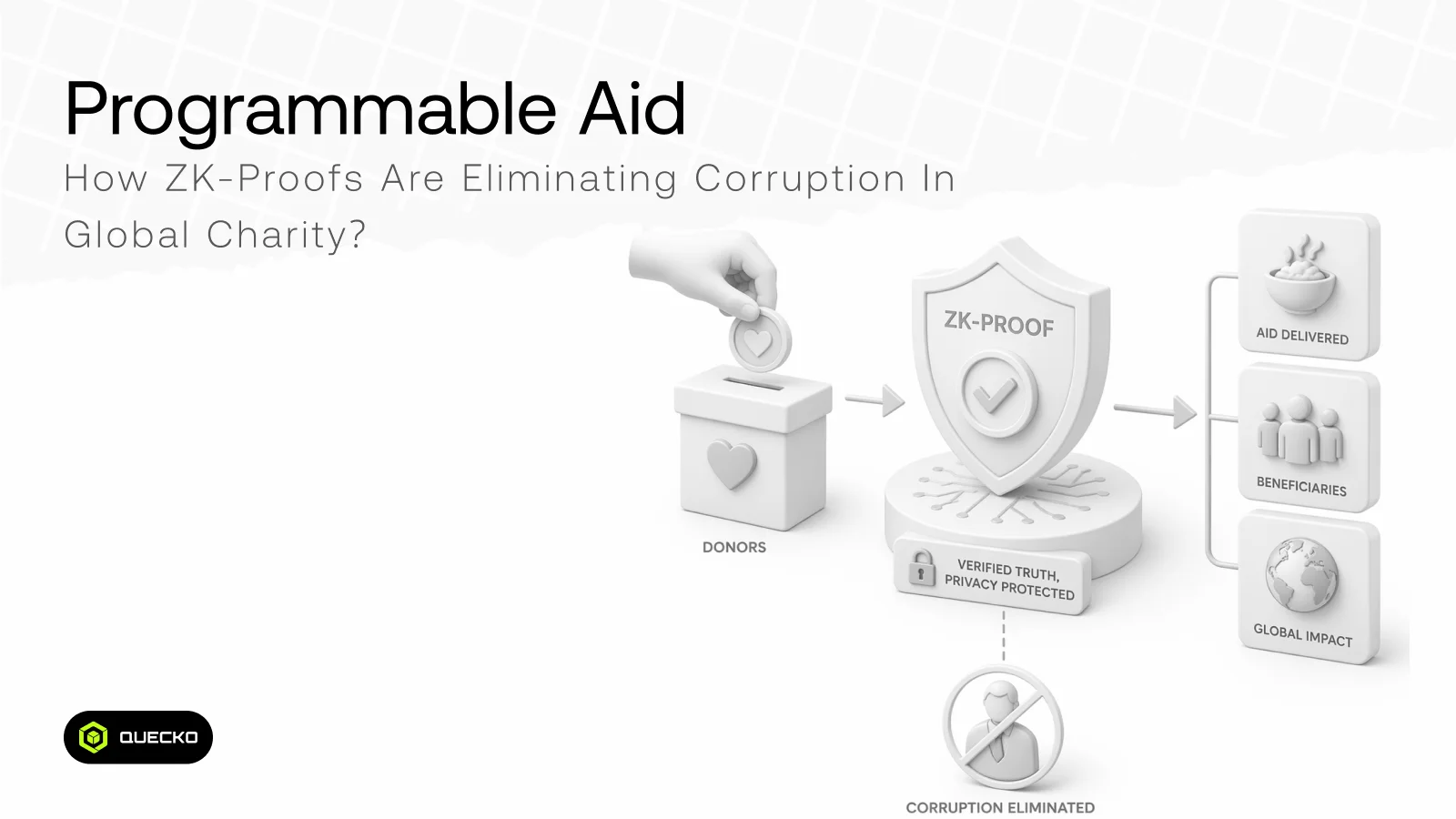
The global charity sector, on a very wide scale, has always been confronted with essentially one big problem: trust. Every year, billions of dollars are transferred through the humanitarian ecosystem, but despite this, issues such as a lack of transparency, misuse of funds, and inefficiency in aid delivery continue to arise.
There is an upsurge of a new mode of thinking: Programmable Aid powered by zero-knowledge proofs. When supplemented with a blockchain framework, smart contracts, and transparent financial systems, this approach is fundamentally changing the manner in which global contributions to charities are tracked, authenticated, and dispatched.
ChainScore Labs and similar entities are exploring ways to use cryptographic validation to ensure accountability while protecting privacy.
Many modern experiments in this space also explore tokenized vouchers as a way to simplify how aid is accessed in real-world scenarios.
What is Programmable Aid?
Programmable Aid denotes the application of blockchain technology in situations where aid is regulated through smart contracts, instead of being done manually by third parties.
Instead of the conventional paper trail and third-party auditing, the money is:
- Locked into programmable conditions
- Released automatically when conditions are met
- Verified through cryptographic proofs
In some modern systems, assistance is even issued as a digital token, making it easier to distribute and verify value instantly.
This creates a trustless system where corruption becomes significantly harder.
Many implementations also rely on tokenized vouchers to make aid more practical in real-life usage.
Role of Blockchain Infrastructure in Aid Systems
At the core of this transformation is blockchain infrastructure.
Blockchain provides:
- Immutable records of transactions
- Transparent tracking of funds
- Real-time verification of aid distribution
Blockchain records the donations from their source until they reach their destination without any leakages. It increases transparency, a distributed ledger system, and auditability, which are fast becoming crucial aspects of international aid programs.
Role of Public Ledger in Programmable Aid
A public ledger is the foundation that ensures every transaction in programmable aid systems is transparent and verifiable.
In blockchain-based humanitarian systems, a public ledger:
- Records every donation and aid distribution event
- Makes all smart contract execution visible and auditable
- Prevents hidden manipulation of funds
- Provides real-time verification of humanitarian flows
This guarantees enhanced transaction traceability, immutability of audit trails, and improved fraud prevention processes within donation channels.
In contrast to traditional databases, a public ledger cannot be changed after data has been stored in it. This is necessary to prevent corruption within global charity networks.
Continuous usage of the public ledger makes all parties accountable, from individual donors to NGOs and governments.
For example, the World Food Programme uses a public ledger to ensure that the resources and funds donated to beneficiaries reach their destination.
The idea of zero-knowledge proof helps maintain privacy for the beneficiaries without compromising the transparency of the public ledger.
Unlike conventional databases, a public ledger is immutable, meaning that once information is entered into the system, it cannot be modified. This is important to prevent corruption within the global humanitarian sector.
By integrating the concept of zero-knowledge proof, the public ledger remains transparent while protecting private beneficiary information.
Zero-Knowledge Proofs: Privacy with Transparency
One of the most powerful innovations driving this system is zero-knowledge proofs.
This process allows the verification of something without giving out any critical information.
In global aid systems, this means:
- People can show that they have access to benefits without compromising their identity.
- The funds received by these people may be authenticated without giving away any financial details about them.
- Funds can be verified without exposing personal financial data.
- Governments and NGOs may audit these processes without accessing any private information from these individuals.
This ensures trust without putting the user’s privacy at risk. It also ties into other privacy-first systems for verifying and authenticating through zk-SNARKs in Web3 infrastructure.
ChainScore Labs and Verification Systems
Innovators like ChainScore Labs are building frameworks that connect identity, funding, and distribution systems using cryptographic verification.
ChainScore Labs focuses on:
- Fraud detection in humanitarian funding
- Verifiable donor-to-recipient tracking
- Integration of blockchain-based audit systems
By embedding ChainScore Labs solutions into aid networks, organizations can ensure that every transaction is verifiable and tamper-proof.
Smart Contracts in Global Aid Distribution
At the heart of programmable charity are smart contracts.
These self-executing agreements automate:
- Release of funds
- Verification of conditions
- Monitoring of aid distribution
For example:
- Funds for food relief are released only when delivery confirmation is recorded.
- Disaster relief payments are triggered when satellite data confirms impact zones.
Because everything is coded into smart contracts, human manipulation becomes nearly impossible.
In large-scale humanitarian systems like the World Food Programme these contracts can dramatically improve efficiency.
The Role of the World Food Programme in Digital Transformation
The World Food Programme is one of the largest humanitarian organizations experimenting with blockchain-based systems.
In modern implementations, the World Food Programme uses digital tools to:
- Track food shipments in real time.
- Reduce fraud in refugee aid systems.
- Improve transparency in aid distribution.
These systems increasingly integrate tokenized vouchers, allowing aid to be delivered digitally instead of physically.
In a few pilot projects, tokenized vouchers for food and cash assistance are a means to ensure quicker delivery.
The World Food Programme is also investigating the potential of smart contracts to automate the logistics of crisis response, thus facilitating faster delivery of assistance.
Tokenization Platforms and Digital Assets
Modern humanitarian systems are increasingly using tokenization platforms to represent real-world aid as digital assets.
This enables:
- Faster transfers of value
- Transparent fund allocation
- Reduced dependency on traditional banking systems
In this model, digital tokens represent food vouchers, medical aid, or cash assistance. This is part of a growing shift toward real-world asset tokenization, digital value representation systems, and blockchain-based resource allocation models.
This is part of a growing transition to real-world asset tokenization, systems for representing value digitally, and allocation models of resources based on a blockchain.
These digital tokens may be monitored, authenticated and can be redeemed with security, thereby ensuring that the aid reaches the beneficiaries. Meanwhile, tokenized vouchers also facilitate that people can get and use this assistance in their day-to-day life without any delay or misunderstanding.
Digital Identity and Access Control
A crucial component of programmable aid is digital identity.
With secure identity systems:
- Beneficiaries can be verified without storing sensitive personal data.
- Fraudulent claims are reduced.
- Access to aid becomes more equitable.
When paired with zero-knowledge proofs, digital identity guarantees that a person’s eligibility can be checked without revealing their private data. Tokenized vouchers, on the other hand, can also be associated with verified identities, enabling more secure distribution. Such systems are frequently based on self-sovereign identity (SSI) architecture and decentralized identity verification protocols, which are becoming more and more popular in Web3 applications.
Digital Wallets and Financial Inclusion
Digital wallets are essential in delivering humanitarian aid in a more effective way.
They allow beneficiaries to:
- Receive funds instantly
- Store digital assets securely
- Access aid without traditional banking systems
In numerous parts of the world, digital wallets serve as an entry point for financial inclusion.
For example, the World Food Programme is one of the organizations that has experimented with digital wallets for providing cash-based support in emergency areas.
Regular usage leads to the acceleration, security, and transparency of the distribution of assistance.
Vouchers secured as tokens in the digital wallets allow for the ease and speed of redemption.
Reducing Transaction Costs in Aid Systems
Traditional humanitarian systems suffer from high administrative overhead and banking fees.
Blockchain-based systems significantly reduce transaction costs by:
- Removing intermediaries
- Automating verification through smart contracts
- Using decentralized payment systems
- Digital tokens also help streamline cross-border transfers.
Lower transaction costs mean more funds reach beneficiaries directly.
Additionally, optimized routing of funds reduces unnecessary transaction costs, improving efficiency at scale.
Even small reductions in transaction costs (common inefficiencies in legacy systems) can significantly increase the impact of global aid budgets.
DeFi Infrastructure in Humanitarian Aid
DeFi infrastructure is gradually being explored for humanitarian funding systems.
It enables:
- Transparent lending pools for emergency aid
- Yield generation for donation sustainability
- Automated liquidity for crisis response
By integrating DeFi infrastructure, humanitarian organizations can create self-sustaining funding ecosystems.
Aid Distribution Transparency
One of the biggest benefits of programmable systems is transparent aid distribution.
With blockchain and smart contracts, every stage of aid distribution is recorded and verifiable.
This reduces:
- Misallocation of resources
- Duplicate claims
- Administrative delays in aid distribution
- Tokenized vouchers ensure every step of delivery remains traceable.
- It also enhances supply chain traceability, end-to-end donation tracking, and real-time humanitarian reporting systems.
Repeated optimization of aid distribution ensures faster humanitarian response in disaster zones.
How ChainScore Labs Enhances Aid Transparency
As mentioned earlier, ChainScore Labs plays a critical role in building verification layers for global aid systems.
By using ChainScore Labs, organizations can:
- Monitor fund flows in real time.
- Validate recipient authenticity.
- Strengthen accountability in aid distribution.
The dual integration of ChainSscore Labs with blockchain systems ensures higher trust in humanitarian operations.
The Future of Programmable Aid
The future of global charity is moving toward fully automated, transparent systems powered by:
- smart contracts
- zero-knowledge proofs
- blockchain networks
- digital wallets
- tokenized ecosystems
In this system:
- Donations are traceable
- Fraud is minimized
- Efficiency is maximized
- Beneficiaries receive faster support.
The main thing is, corruption becomes almost impossible from a structural point of view.
In the up-coming humanitarian systems, digital tokens along with tokenized vouchers will significantly flourish.
Besides that, tokenized vouchers will still be changing as a convenient way to connect digital platforms with the physical distribution of aid, thereby facilitating the process to be more direct and accessible to end users.
This shift goes in deep accord with Web3 humanitarian platforms, AI-assisted resource distribution mechanisms, and the decentralized aid networks of the future.
How Quecko Supports Programmable Aid
Quecko helps build the tech behind transparent and reliable aid systems. Building blockchain infrastructure, decentralized apps, and smart contracts enables real-time tracking of funds, automating the delivery of aid, and securely recording all transactions. This minimizes misuse and contributes to making global charity work more transparent and effective.
Conclusion
Programmable Aid is a fundamental change in the way humanity thinks about global charity.
The world is heading to a more transparent and efficient humanitarian model through the combination of blockchain infrastructure, smart contracts, zero-knowledge proofs, and other systems such as ChainScore Labs.
The World Food Programme is using digital transformation to demonstrate how digital transformation can improve aid distribution, reduce the costs of transactions, and increase accountability.
Besides being digital, humanitarian aid in the future generation will be verifiable, programmable, and trustless as well.
FAQs
1. What is Programmable Aid?
Programmable aid is a blockchain-backed platform with smart contracts that automatically carry out and check the distribution of aid in a completely transparent manner.
- How do zero-knowledge proofs help in charity systems?
They allow verification of eligibility and transactions without revealing private data, improving privacy and trust.
- What role does the World Food Programme play in blockchain adoption?
The World Food Programme implements digital tools and digital wallets to increase transparency and efficiency in delivering humanitarian aid.
- How do digital wallets improve aid delivery?
Digital wallets enable instant, borderless, and secure distribution of digital assets to beneficiaries.
- What is the benefit of tokenization platforms in aid?
Tokenization platforms convert aid into traceable digital assets, ensuring transparency and reducing fraud.
- How does ChainScore Labs contribute?
ChainScore Labs builds verification systems that improve transparency and reduce corruption in global aid networks.
- What role does Quecko play in blockchain-based humanitarian systems?
Quecko builds the systems that allow aid to be distributed transparently and automatically, helping organizations reduce fraud and ensure support reaches the right people.
Author

Khola Abbasi
No description availableDate
17 days agoShare on

Related Blogs
$150 Oil: How Did We Get Here and What Comes Next?
24 hours ago
How Blockchain Is Transforming Digital Marketing Transparency
1 day ago
How Crypto Projects Generate Revenue: Beyond Token Hype
2 days ago
How USDT Powers the Crypto Economy: Liquidity, Trading & Revenue
3 days ago








 +971-50-740-0268