

How RWAs Outperformed Crypto in April 2026
Tokenized real world assets hit $30B while crypto fell. See which asset classes led, who the top issuers are, and what it means for builders.
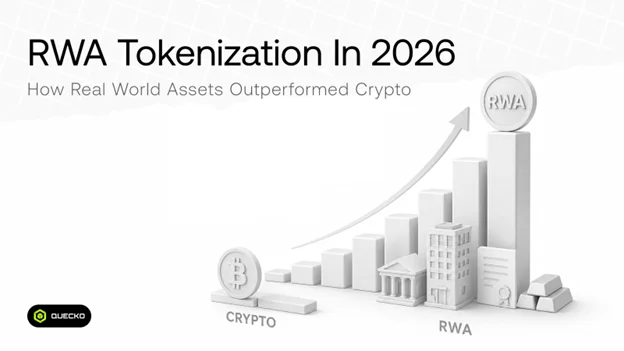
In April 2026, most of the crypto market was falling. Bitcoin dropped under geopolitical pressure. The Crypto Fear and Greed Index sat at 26. Yet one corner of blockchain kept growing.
Tokenized real world assets (RWAs) reached $27.6 billion in April 2026, up roughly 4%, while the broader market declined. By April 27, RWA.xyz showed the figure had already crossed $30.1 billion, up 9.25% in just 30 days.
Tokenized RWAs are blockchain tokens that represent ownership in real assets, such as government bonds, private loans, gold, and real estate. Unlike speculative crypto tokens, these instruments are backed by real collateral and generate yield. They behave more like financial products than crypto bets.
This article explains what drove the April milestone, which asset classes and platforms are leading tokenization, where the biggest risks still sit, and why South Asia is becoming an important market to watch. Whether you are an investor, a builder, or just trying to understand the space, the April 2026 data has clear signals worth paying attention to.
What Are Tokenized Real World Assets?
Real-world asset (RWA) tokenization is the process of converting ownership rights in an off-chain asset into a blockchain token. A regulated custodian holds the asset. A smart contract governs who owns it, how yield is distributed, and who can transfer it.
The practical advantages over traditional financial infrastructure are significant:
- Settlement speed: Tokenized assets settle in near real-time, compared to T+1 or T+2 in legacy markets.
- 24/7 liquidity: Tokens trade continuously, unlike traditional securities that are confined to market hours.
- Fractional ownership: Assets that once required $1M+ minimums can now be accessed at much lower thresholds.
- Programmable yield: Interest accrues and distributes automatically via smart contract, with no manual processing required.
- DeFi composability: Tokenized assets can be used as collateral in lending protocols without needing to be sold first.
Unlike speculative crypto tokens, tokenized RWAs are yield-bearing instruments backed by real collateral. That distinction is what made them resilient when crypto sentiment turned negative in April 2026.
The $27.6B Milestone: Growth in Context
The April 2026 figure does not exist in isolation. According to RWA.xyz, the total value of tokenized real-world assets on public blockchains grew from approximately $21 billion at the start of 2026 to around $27.5 billion by the end of Q1, a 30% increase in just three months.
Zoom out further and the picture is even more striking. The market grew 380% in three years, from roughly $5 billion in early 2022 to over $24 billion by mid-2025, according to a joint report by RedStone, Gauntlet, and RWA.xyz.
Key tokenized RWA growth milestones:
| Date | Market Size | Notable Event |
| Q1 2022 | ~$5 billion | Mostly experimental; early gold and private credit pilots |
| Q1 2023 | ~$6.5 billion | Tokenized Treasury pilots begin at an institutional scale |
| Q1 2025 | ~$21 billion | Institutional inflows accelerate after Bitcoin spot ETF approval |
| Q1 2026 | ~$27.5 billion | 30% quarterly growth; six asset classes each cross $1B |
| Apr 27, 2026 | $30.1 billion | +9.25% in 30 days; market rises during broad crypto selloff |
| Sources: RWA.xyz | Investax Q1 2026 Report | CoinDesk | ||
What makes the April figure significant is not just its size. It is when the growth happened. Tokenized gold alone surged 227% year-over-year, rising from $1 billion to over $3.27 billion, as investors sought stable on-chain yield during the selloff.
Which Asset Classes Are Driving RWA Tokenization?
The tokenized RWA market covers six distinct asset classes, each of which has independently surpassed $1 billion on-chain, according to CoinDesk. Here is how the landscape breaks down.
Tokenized U.S. Treasuries
This is the fastest-growing RWA segment by both percentage and absolute value. Tokenized U.S. Treasuries expanded from $380 million in Q1 2023 to over $14 billion in Q1 2026, a 37x increase with a compound annual growth rate of 230%.
The appeal is straightforward. Tokenized Treasuries offer yields of approximately 3.5 to 4% APY, daily yield distribution, and on-chain composability. That means they can function as DeFi collateral without the holder needing to exit the position.
According to the Investax Q1 2026 RWA Tokenization Market Report, the largest products by AUM include: Circle USYC ($2.7B), Ondo Finance ($2.6B), BlackRock BUIDL ($2.4B), Franklin Templeton BENJI ($1.0B), and WisdomTree WTGXX ($861M).
Tokenized Private Credit
Private credit remains the largest segment of the tokenized RWA market by total value. Active on-chain private credit exceeded $18.91 billion as of late 2025, with cumulative originations reaching $33.66 billion, per RWA.xyz.
Leading protocols Centrifuge, Maple Finance, and Goldfinch have originated over $3.2 billion in on-chain loans. Yields typically range between 8% and 12% for senior tranches, roughly double what tokenized Treasuries offer.
Maple Finance closed 2025 with $4.59 billion in assets under management. Centrifuge has supported over $2 billion in tokenized assets across 7 chains, with integrations into Sky, Aave, and Morpho.
Tokenized Commodities
Tokenized commodities, primarily gold via Paxos Gold (PAXG) and Tether Gold (XAUT), have become a natural hedge during crypto drawdowns. As of Q1 2026, tokenized commodities reached $7.3 billion in market capitalization, making this the third-largest tokenized asset class.
The pattern in April 2026 was clear. When crypto fear spiked, capital rotated into gold-backed tokens. On-chain commodity exposure gives investors a hedge without requiring a traditional brokerage account.
Who Leads the Tokenized RWA Market?
The competitive landscape has consolidated around a small number of institutional-grade platforms. Here is a comparison of the top issuers by asset class, AUM, and blockchain:
| Platform | Asset Class | AUM / TVL | Min. Investment | Blockchain(s) |
| BlackRock BUIDL | U.S. Treasuries | $2.4B | $5,000,000 | Ethereum, Solana, Polygon |
| Ondo Finance | U.S. Treasuries | $2.6B | $5,000 / Low | Ethereum, Solana, Injective |
| Circle USYC | U.S. Treasuries | $2.7B | Institutional | Ethereum |
| Franklin Templeton BENJI | U.S. Govt MMF | $1.0B | Low (retail) | Stellar, Ethereum, Solana |
| Maple Finance | Private Credit | $4.6B AUM | Institutional | Ethereum, Solana |
| Centrifuge | Private Credit | $2B+ | Varies by pool | Ethereum + 6 others |
| Paxos Gold (PAXG) | Tokenized Gold | ~$2.3B | Fractional | Ethereum |
| Sources: Investax Q1 2026 Report | SpotedCrypto | CoinBrain | ||||
BlackRock BUIDL remains the benchmark for institutional tokenization. Since launching in March 2024, it has become the largest single tokenized product in existence, attracting over $2.4 billion in assets. It holds a position as standard collateral on major platforms, including Crypto.com and Deribit.
When the world’s largest asset manager put its balance sheet behind tokenized Treasuries, it sent a signal that no amount of crypto-native advocacy could replicate. Other institutions followed.
Why Did Tokenized RWAs Grow During a Crypto Downturn?
The +4% gain during a broad market selloff reveals something structural, not cyclical. Three factors explain it.
Institutional capital does not follow retail fear. The money flowing into tokenized Treasuries and private credit comes from asset managers, family offices, and corporate treasury departments. Their mandates are yield-seeking and risk-adjusted. They do not respond to price charts the way retail traders do.
Regulatory clarity is pulling capital in. The EU’s MiCA framework is in full effect in 2026, requiring firms to hold CASP authorization and creating a regulated single market. In practice, MiCA compliance shapes the token itself: transfer restrictions, whitelist logic, and yield distribution rules are encoded directly into the smart contract, not added afterwards. In the U.S., the NYSE announced a dedicated 24/7 tokenized securities venue with on-chain settlement, and Nasdaq received SEC approval for tokenized equity trading.
RWAs serve a different function than crypto-native tokens. As Kevin Rusher, founder of RWA lending protocol RAAC, noted: “Tokenized RWAs will provide a firm footing that means liquidity will stay in crypto even when times get tough.” That observation proved accurate in April 2026.
The Challenges That Remain
The $27.6 billion figure deserves honest context. Against a $147 trillion global equities market, tokenized RWAs remain a rounding error. Three structural challenges still slow down mass adoption.
Liquidity depth. A 2025 academic study published on arXiv found that despite over $25 billion in tokenized RWAs on-chain, most tokenized assets show low secondary-market trading volumes and long holding periods. Issuing a token is not the same as creating a liquid market. Conflating the two is the most common mistake institutional buyers make when evaluating on-chain RWAs.
Walled gardens. Most tokenized RWAs live in permissioned platforms, not open DeFi. According to the State of RWA Tokenization 2026 report by RWA.io and Canton Network, fragmentation across chains is already producing 1 to 3% pricing gaps for identical assets and 2 to 5% friction when moving capital across chains. For institutional allocators managing tight mandates, those are not acceptable inefficiencies.
Custody infrastructure. The joint IA and IMAS report highlighted that traditional custodians are still building capabilities to support digital wallets, smart contract governance, and tokenization platform interoperability. Fiduciary investors need custody frameworks that match the maturity of traditional finance, and the industry is not there yet.
Long-Range Forecasts: How Big Could This Get?
The forecasts for tokenized RWA growth vary widely, but even the conservative ones imply a dramatic expansion from current levels:
- McKinsey projects $2 trillion by 2030
- Standard Chartered targets $30 trillion by 2034
- Ripple and BCG jointly forecast $18.9 trillion by 2033
Even at the conservative end, these ranges imply a 70x expansion from current levels. Centrifuge COO Jurgen Blumberg has projected RWA token TVL will exceed $100 billion by the end of 2026, with more than half of the world’s top 20 asset managers launching tokenized products. A $100 billion milestone in a single year would represent roughly a 4x increase, aggressive but not implausible given Q1’s 30% quarterly growth rate.
The South Asia Signal: Why Pakistan Matters
Every major publication covering RWA tokenization focuses on the same geography: the US, the EU, and the Gulf. None of them isare writing for the market that may be the most consequential emerging entry point, South Asia, and specifically Pakistan.
In December 2025, Pakistan’s Finance Ministry signed an MoU with Binance to explore tokenizing up to $2 billion in sovereign bonds, treasury bills, and commodity reserves. This is the first sovereign-level RWA tokenization commitment in South Asia. The initiative is overseen by PVARA, Pakistan’s Virtual Assets Regulatory Authority, which gained permanent legal status under the Virtual Assets Act 2026. The country now counts an estimated 40 million crypto users, roughly 17% of its population, a retail base larger by user count than Germany’s or Japan’s, operating under a formal regulatory framework for the first time.
The structural fit with tokenized RWAs is direct. Consider three factors:
- Pakistan’s $30+ billion in annual remittance flows are a natural candidate for dollar-linked stablecoin infrastructure.
- Its commodity reserves, including gold and agricultural assets, are precisely the asset classes driving global tokenized commodity growth.
- PVARA is mandated to advise the government on tokenization, meaning the legal architecture for RWA issuance is being built from the ground up with tokenization explicitly in scope.
What happens in Islamabad over the next 18 months will set the template for how the rest of South Asia approaches sovereign RWA issuance.
Final Thoughts
The $27.6 billion figure is the entry point, not the headline. As of April 27, 2026, RWA.xyz shows the market has already crossed $30.1 billion, up 9.25% in 30 days, during a crypto selloff. In our view, that single data point tells you more about where institutional capital is actually going than any price chart.
We believe the liquidity and custody gaps are engineering problems, not structural limits. The economic incentive to solve them has never been larger. When BlackRock, McKinsey, and the NYSE are all pointing at the same destination, the question is no longer whether tokenized real world assets matter. It is who builds the infrastructure that captures the growth.
Watch tokenized Treasuries and private credit for the clearest signals. If you are building in this space, the infrastructure choices you make now will determine whether you can scale when the market hits $100 billion. That is exactly where Quecko comes in. Quecko specializes in production-grade RWA and DeFi development: multi-chain deployment, on-chain lending integrations, and smart contract architecture.
With 500+ blockchain projects delivered, if you have a tokenization project in scope, start a conversation at quecko.com.
Frequently Asked Questions
1. What exactly are real world asset tokens?
Real world asset tokens are blockchain-based digital representations of physical or financial assets like bonds, gold, or real estate. They give you ownership rights on-chain, backed by real collateral.
2. Why have real-world assets recently outperformed crypto investments?
RWAs are backed by yield-generating assets and attract institutional capital, so they hold value when crypto sentiment drops. They respond to interest rates and regulation, not fear and greed indexes.
3. What are the best-performing real-world asset funds compared to crypto coins?
In Q1 2026, tokenized private credit protocols like Maple Finance ($4.6B AUM) and Treasury funds like Circle USYC ($2.7B) outperformed most altcoins while Bitcoin posted losses.
4. How do tokenized assets compare to traditional cryptocurrencies in terms of risk and stability?
Tokenized RWAs are backed by real collateral and generate fixed yield, making them significantly more stable than speculative crypto tokens. The tradeoff is lower liquidity and longer lock-up periods.
5. How to shift my portfolio from crypto to real-world assets with leading brokers?
Platforms like Ondo Finance, Franklin Templeton BENJI, and Maple Finance offer direct access to tokenized RWAs with varying minimums. Most require KYC verification and support Ethereum or Solana wallets.
6. Which platforms offer real-world asset investment options that outpace crypto returns?
Maple Finance (8-12% private credit yield), Ondo Finance USDY, and BlackRock BUIDL are currently the most established options with verified track records across multiple market cycles.
Author

Sana Tariq
No description availableDate
5 hours agoShare on

Related Blogs
Aster vs Emerging Altcoins: Which Has Better ROI Potential?
3 hours ago

AI + Blockchain Are Reshaping Web3 Marketing
3 hours ago
How RWAs Outperformed Crypto in April 2026
5 hours ago

How Blockchain Gaming Is Evolving Beyond Play-to-Earn
4 days ago








 +971-50-740-0268