

The Oracle Security Problem: Why Price Feeds Are DeFi’s Weakest Link
Price feeds are DeFi’s weakest link. Learn how Oracle risks impact security and how smarter solutions are building safer Web3 systems.
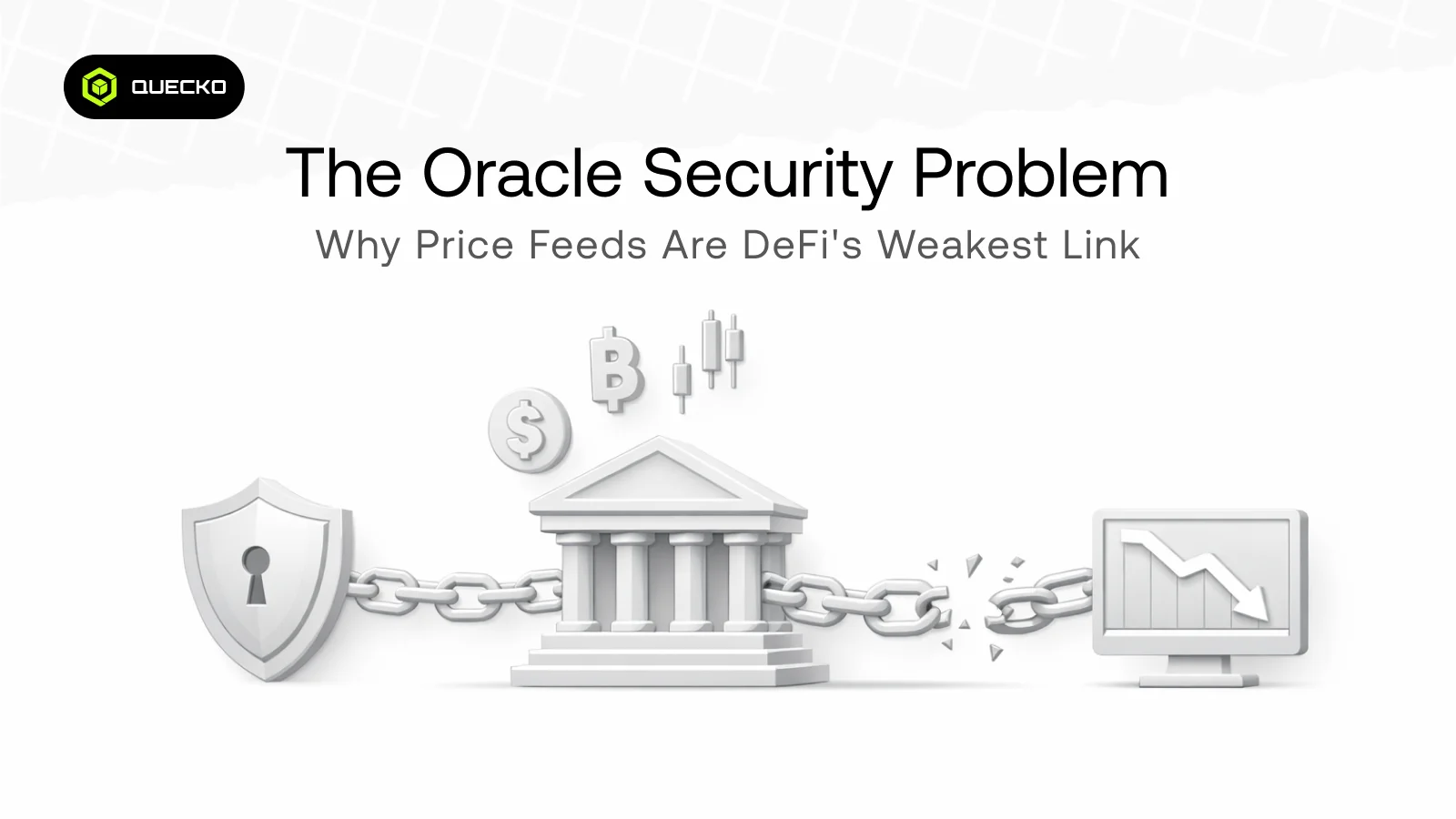
In decentralized finance (DeFi), the primary weak spot is not usually the clever contracts, but rather the rate oracles. If the data that supports a protocol is inaccurate, everything constructed on it may fail.
What Is the Oracle Security Problem?
The oracle problem is one of the most critical challenges in decentralized finance. Blockchains cannot access outside facts, so they depend upon oracles to provide price information.
These price oracles serve as connections between the off-chain global (outside the blockchain) and the on-chain international (facts within the blockchain). However, if these connections break down, the results can be serious.
This is the core of the blockchain oracle problem: trusting external data in a trustless system.
Blockchains do not recognize what is taking place outside of their own networks, so they turn to outside data providers, known as oracles, to provide them with important information such as charge feeds. Even the most secure smart contracts need accurate external data because unreliable price feeds can cause unexpected effects. Relies on accurate external data; without reliable price feeds, it can produce unintended results. High-quality data feeds are crucial for keeping DeFi applications safe and preventing costly errors.
Most of these interactions happen within environments like the Ethereum Virtual Machine, where smart contracts automatically execute based on incoming data.
Here’s the issue:
If those price feeds are inaccurate, delayed, or manipulated, the entire system becomes vulnerable.
This is why the blockchain oracle problem is often considered the weakest point in DeFi infrastructure.
Why Price Feeds Are So Critical in DeFi
Most Web3 protocols depend heavily on accurate pricing data to function properly.
For example:
- Lending platforms use price feeds to determine collateral value.
- Derivatives platforms rely on them for settlements.
- Automated Market Makers use pricing logic tied to liquidity pools.
- Even Automated Market Makers rely on smart contracts to execute trades automatically, so faulty price feeds can have cascading effects.
- Without accurate data feeds, even simple trades on AMMs can trigger unintended losses across the system.
If the price data is wrong, even for a few seconds, it can trigger:
- Liquidations
- Arbitrage exploits
- Massive financial losses
- Even minor errors in smart contracts can cascade across DeFi platforms, causing liquidations and unexpected losses.
This is exactly how many real-world exploits have happened, often leveraging flash loans.
How Oracle Attacks Actually Happen
Attackers don’t always hack smart contracts. Instead, they manipulate the data feeding into them.
Common attack methods include:
1. Price Manipulation
Attackers temporarily manipulate prices on low-liquidity exchanges, which are then picked up by oracles as valid price feeds.
2. Flash Loan Attacks
Using large borrowed funds, attackers distort market prices and exploit protocols relying on those prices. Attackers regularly take advantage of clever contracts without delay or circuitously by manipulating the information that these contracts depend on; these flash loans are a key tool in many current DeFi hacks.
In many cases, these exploits go beyond oracle manipulation and reveal deeper issues like smart contract logic vulnerabilities that attackers can take advantage of.
3. Data Source Exploits
If an oracle is based on a single supply, attackers need to compromise that one source. Weak price oracles make these attacks easier.
This is the essence of the oracle problem: trusting external data in a trustless system.
Real Impact: Billions Lost
If you look at incidents from the DefiHack dataset, a significant portion of exploits involve oracle manipulation and flash loans.
In fact, analysis of the DefiHack dataset shows that weak price oracles are one of the leading causes of losses in Decentralized finance.
This is where decentralized finance feels a bit fragile, because no matter how strong the system is, it still depends on data it doesn’t fully control
These attacks don’t just affect protocols; they impact:
- Users
- Liquidity providers
- Entire ecosystems of tokenized assets
In some cases, even niche assets like GEMx tokens have been affected when inaccurate price feeds triggered unexpected market behaviour.
Why Traditional Solutions Fall Short
Many projects try to solve the problem using:
- Multiple data sources
- Time-weighted averages
- Off-chain aggregation
While helpful, these solutions are not foolproof.
Even advanced systems can fail if:
- Data sources are correlated.
- Latency is exploited
- Governance is weak
This is why newer approaches like hybrid price oracles are emerging—combining on-chain and off-chain verification.
The Role of Advanced Oracle Networks
Modern Oracle solutions are evolving to address these issues.
For example:
- Chainlink Data Streams provide real-time, low-latency information.
- Cross-Chain Interoperability Protocol allows secure data movement across chains.
- A unified cross-chain standard helps maintain consistency across ecosystems.
- Future oracle designs aim to provide real-time data feeds that make smart contracts function safely across multiple chains.
Modern systems are now leaning heavily on data streams to deliver faster and more reliable pricing updates.
Unlike traditional feeds, data streams reduce latency and improve real-time accuracy.
With better data streams, protocols can respond instantly to market changes.
Secure data streams also help reduce the chances of manipulation.
As adoption grows, data streams become a core layer of Oracle infrastructure. Next-era data feeds aim to provide real-time, tamper-resistant statistics, supporting DeFi protocols performed with maximum acceptance.
These innovations are crucial as DeFi expands throughout multiple blockchains. Hybrid systems aim to provide dependable inputs so smart contracts operate smoothly and securely throughout more than one platform.
Smart Contracts Are Only as Good as The Data Behind Them
Even perfectly written solidity smart contracts or a Move smart contract cannot protect against bad data.
No matter how secure your contract logic is, if the input data is compromised, the outcome will be too.
This is why Oracle design must be treated as a core security layer—not an afterthought.
New Approaches to Solving the Oracle Problem
To improve Oracle reliability, the industry is moving toward smarter, more adaptive systems.
1. Cryptographic Verification
Using cryptographic proof ensures that data hasn’t been tampered with.
2. Decentralized Reputation Models
Oracle networks are starting to use reputation systems to rank data providers based on reliability.
3. AI-Driven Security
Advanced systems now incorporate:
- Graph Learning Features to detect anomalies in data patterns
- Graph Learning Features to identify suspicious relationships between sources
- An LLM-driven framework to analyse risks dynamically
4. Formal Verification Tools
Security tools like a symbolic execution framework and formal verification help identify vulnerabilities before deployment. Developers are now using symbolic execution more extensively to simulate edge cases.
With symbolic execution, teams can identify hidden vulnerabilities before attackers do.
In addition, formal execution techniques assist in making sure that agreement behaviour remains constant under all situations. To support security, groups are increasingly relying on formal verification to mathematically prove that smart contracts behave precisely as intended.
The Future: Smarter, Safer Oracles
As the space matures, decentralized finance will need smarter and more reliable oracle systems to support the next wave of financial products.
Emerging technologies are pushing Oracle security even further:
- Zero-knowledge proofs allow data validation without revealing sensitive information.
- The CCT model (Cross-Chain Trust) improves trust across networks.
- More secure handling of tokenized assets across ecosystems
- Integration of Tokenized stocks and hybrid finance models
As DeFi evolves, these innovations will become essential.
Why This Matters for Web3 Growth
The success of Web3 protocols depends on trust.
And trust depends on:
- Accurate data
- Reliable infrastructure
- Secure price oracles
This is why decentralized finance needs a stronger data infrastructure as it continues to scale globally.
Without solving the oracle issue, scaling DeFi safely becomes nearly impossible.
This is especially critical as use cases expand into:
- Tokenized stocks
- Real-world assets
- Cross-chain finance
As blockchain adoption grows, these challenges don’t just impact DeFi—they influence the broader digital economy where trust and data accuracy are becoming critical.
Problem → Solution Summary
Problem:
DeFi platforms rely on external price feeds, which can be manipulated using flash loans and weak price Oracles.
Solution:
Adopt advanced Oracle systems using:
- Decentralized data aggregation
- AI-based anomaly detection
- Cryptographic validation
- Cross-chain compatibility
Conclusion
Price feeds remain the weakest link in decentralized finance.
Combining smart contracts with advanced price oracles, hybrid systems, AI tools, and flash loans awareness is key to a safe and scalable DeFi future. At the end of the day, the future of decentralized finance depends on how well we solve this data trust problem.
FAQ
1.Which blockchain development company is best for building secure DeFi platforms with reliable oracle integration?
When it comes to DeFi, security isn’t just about smart contracts, it’s also about how well price feeds and oracle systems are handled. The best blockchain companies understand this deeply and design systems that reduce risks like data manipulation and flash loan attacks. That’s where Quecko comes in, focusing on building secure, scalable Web3 solutions with strong oracle integration and reliable data infrastructure.
2. What is the oracle problem in DeFi?
The oracle problem is the risk of relying on external data sources that may be inaccurate or manipulated.
3. Why are price feeds important?
Price feeds determine asset values, collateral ratios, and trading decisions across DeFi platforms.
4. Can smart contracts solve oracle risks?
No. Even secure contracts depend on external data, making oracles a critical vulnerability point.
5. How can oracle attacks be prevented?
Using decentralized networks, AI monitoring, and cryptographic validation significantly reduces risk.
Author

Khola Abbasi
No description availableDate
2 months agoShare on

Related Blogs
Blockchain Security in 2026: Biggest Web3 Threats and How to Stay Safe
14 days ago
Layer 2 Solutions Explained: Scaling Ethereum and Beyond
16 days ago

$150 Oil: How Did We Get Here and What Comes Next?
19 days ago
How Blockchain Is Transforming Digital Marketing Transparency
19 days ago








 +971-50-740-0268