

How Solana’s 15x Stablecoin Surge Decoupled DEX Volume from Ethereum’s Dominance
Solana’s explosive 15x stablecoin growth and rising DEX dominance are reshaping DeFi in 2026, challenging Ethereum’s long-standing leadership and signaling a new multi-chain future.
For years, a single assumption governed decentralized finance: where Ethereum goes, DeFi follows. Total value locked, DEX volume, developer activity, institutional adoption, Ethereum led every metric that mattered, and challengers were measured by how far behind they were, not whether they could overtake it.
That assumption is now structurally broken.
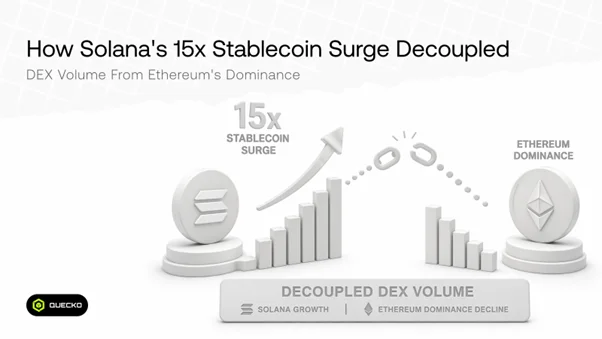
In February 2026, Solana’s monthly DEX volume hit $117 billion, more than doubling Ethereum’s $52 billion for the same period. (Spoted Crypto) By April, Solana’s seven-day DEX spot volume stood at $11.49 billion against Ethereum’s $7.62 billion, a 51% lead that persists across multiple timeframes, according to DefiLlama data. (Crypto rank) Meanwhile, Solana’s non-USDC/USDT stablecoin supply surged roughly 15 times since January 2025, reaching $3.8 billion in total capital inflow. (CoinMarketCap)
This is not a memecoin traffic spike. It is a structural reallocation of on-chain economic activity, driven by fee advantages, protocol innovation, institutional capital, and a new generation of narrative-defining sectors that Solana happens to be hosting. Understanding it matters not just for traders, but for anyone building, investing, or allocating capital in Web3 in 2026.
Why Solana Is Outpacing Ethereum
Solana’s rise to DEX dominance is not a single-variable story. It is the compounding result of a faster architecture, a superior user experience, and a fundamentally different vision for what a blockchain should do, one that happens to align perfectly with where on-chain trading activity is going.
The Fee Advantage That Rewired Trader Behaviour
The bluntest explanation for Solana’s DEX dominance is economics. Solana processes 5,500+ TPS, with transaction fees of $0.00025 compared to Ethereum’s $3 average. When a swap costs a fraction of a cent, strategies that were economically unviable on Ethereum, including high-frequency arbitrage, automated DCA positions, and micro-swaps on long-tail tokens, become standard practice. Volume follows cheapness.
One Chain, One State, Zero Friction
Cost alone does not explain the full picture. Every stablecoin dollar on Solana turns over 6x faster than on Ethereum, despite Ethereum holding 66.5% of all USDC supply. Solana’s monolithic, single-state design means no bridges, no rollup fragmentation, and no multi-step routing across L2s, giving traders one mempool, one fee market, and one execution environment. The user experience is measurably more coherent.
Two Chains, Two Theses, Both Winning
Ethereum’s Pectra upgrade doubled blob throughput, with Glamsterdam and Hegotá slated for later in 2026, meaningful improvements that reinforce its modular settlement thesis rather than challenge Solana’s execution lead. Ethereum is becoming the vault where institutional capital sits; Solana is becoming the engine where that capital moves. The DeFi hierarchy has not inverted, it has bifurcated.
Tracking the 15x Stablecoin Explosion and the Institutional Influx
The stablecoin surge is the most significant structural signal in Solana’s 2026 story, because stablecoins are not speculative instruments, they are working capital. Their growth indicates that real economic activity, not just trading, is migrating to the network.
Solana’s stablecoin supply surged 15 times since January 2025 to $3.8 billion, with the February 2026 record volume of $650 billion overtaking Ethereum’s $525 billion for the same period. That capital is not sitting idle. It is being deployed into DEX liquidity pools, lending markets, staking positions, and increasingly, into real-world asset products.
| Metric | Solana | Ethereum | Source |
| Weekly DEX Volume (April 2026) | $11.49B | $7.62B | DefiLlama |
| Monthly DEX Volume (Feb 2026) | $117B | $52B | AMBCrypto |
| DeFi TVL (April 2026) | $6.3B | $55.6B | DefiLlama |
| Stablecoin Turnover Velocity | 6x faster | Baseline | AOL |
| RWA Tokenized Value (March 2026) | $1.82B | $12.3B+ | RWA.xyz, TradingView |
| Daily Transactions Peak (Feb 2026) | 160M | ~5M | Blockworks |
Institutional names are providing the underlying demand. Western Union selected Solana to build its stablecoin remittance platform for 150 million customers across 200 countries, expected to deploy in the first half of 2026. BlackRock’s BUIDL fund and Ondo Finance’s tokenized Treasury products have both established Solana positions.
Solana achieved more than $1 trillion in economic activity in Q1 2026. a first in its history, driven by high DEX volumes, DePIN networks, and on-chain transactions. The stablecoin explosion is not a retail phenomenon. It is institutional capital finding its trading venue.
How Jupiter and Phoenix Replaced Uniswap as the New DEX Standard
Solana’s volume lead does not exist in a vacuum, it was built on infrastructure. The protocols that emerged to serve Solana’s trading ecosystem did not simply replicate Ethereum’s DEX model at lower cost. They rearchitected it, and in doing so created a more capable, more composable, and more institutionally credible trading environment than anything currently available on the EVM.
Jupiter: The Routing Layer That Became a DeFi Superapp
Jupiter Exchange handles approximately 95% of all aggregator market share on Solana and over 50% of total Solana DEX trading volume, not by being a DEX itself, but by simultaneously scanning liquidity across Raydium, Orca, Meteora, Phoenix, and 50+ other venues to find the optimal execution path for every swap. When a user trades on Solana, they are almost always trading through Jupiter, whether they know it or not.
From Swap Tool to Full Financial Platform
What started in 2021 as a simple routing tool has evolved into what its founders call a “DeFi superapp”, offering token swaps, limit orders, perpetuals trading with up to 100x leverage, lending, liquid staking, a native stablecoin (JupUSD), and as of February 2026, integrated prediction markets via a Polymarket partnership. In three years, Jupiter built what Uniswap took five to establish, and went significantly further.
Phoenix: The Order Book That Institutions Actually Need
Phoenix fills the gap Jupiter’s AMM-aggregator model cannot, providing a fully on-chain central limit order book (CLOB) with maker-taker matching and deterministic fills at exact prices, the architecture of a proper exchange rather than a liquidity pool. Together, Jupiter, Phoenix, and OpenBook now regularly cross $2 to $3 billion in daily volume, rivaling mid-tier centralised exchanges and giving institutional traders and algorithmic desks the price certainty and depth they require.
DePIN and RWA Narrative Drivers Powering Sustainable Volume
Volume driven by speculation evaporates. Volume driven by utility compounds. Solana’s sustained DEX and stablecoin growth in 2026 is increasingly underpinned by two structural narratives that generate genuine, recurring on-chain economic activity: DePIN (Decentralised Physical Infrastructure Networks) and RWA tokenization.
DePIN projects, networks that use blockchain incentives to coordinate real-world infrastructure like wireless coverage, GPU compute, energy grids, and mapping, generate continuous on-chain transactions that are not correlated with crypto price cycles. Solana is the dominant home for this category.
Projects like Helium (wireless), io.net (GPU compute), and Hivemapper (mapping) all chose Solana for its throughput and fee model. Solana’s $1 trillion in Q1 2026 economic activity was explicitly driven in part by DePIN networks, real infrastructure usage creating real transaction volume.
On the RWA side, the growth is even more striking. Solana’s RWA ecosystem hit a record $1.82 billion in tokenized value in March 2026, up from $873 million at the start of the year, a doubling in under three months. Solana’s tokenized RWAs, excluding stablecoins, crossed $2 billion in market value in April 2026, representing approximately 10x growth over the prior year, driven primarily by tokenized equities.
Galaxy Research projects Solana’s Internet Capital Markets will reach $2 billion in 2026, while analysts at Bitwise have predicted a new all-time high for SOL if the U.S. CLARITY Act passes, which prediction markets currently assign a 68% probability. These are not speculative narratives.
They are yield-bearing, institutionally-backed, regulatory-aligned asset classes that will generate baseline on-chain volume regardless of crypto market conditions.
Is Solana’s Dominance Permanent?
The honest answer is: not automatically. Solana’s DEX lead is real and data-backed, but it carries structural risks that Ethereum does not.
Ethereum holds $55.6 billion in DeFi TVL, 68% of the global $94 billion market, compared to Solana’s $6.3 billion. Deep liquidity attracts institutional capital, and institutional capital attracts deeper liquidity.
That virtuous cycle is not easily disrupted. Ethereum also leads in developer count with 31,869 active developers versus Solana’s 17,708, and developers build the protocols that attract users.
Solana’s security history adds further nuance. The Drift Protocol exploit in April 2026, which drained $285 million by weaponising Solana’s own durable nonces feature, was a reminder that high-performance architecture introduces novel attack surfaces that slower, more conservative chains never encounter. Fast and cheap only maintains its appeal if it remains safe.
What Solana has demonstrated in 2026 is that it can win the trading layer decisively, in volume, velocity, and user experience, while Ethereum continues to dominate the settlement and custody layer.
The more interesting question is not whether Solana will permanently displace Ethereum, but whether the bifurcation itself is the permanent new state of DeFi: one chain where capital is stored, another where it moves. The data increasingly says yes.
Author

Sana Tariq
No description availableDate
1 month agoShare on

Related Blogs

Blockchain Security in 2026: Biggest Web3 Threats and How to Stay Safe
13 days ago
Layer 2 Solutions Explained: Scaling Ethereum and Beyond
15 days ago

$150 Oil: How Did We Get Here and What Comes Next?
18 days ago

How Blockchain Is Transforming Digital Marketing Transparency
18 days ago








 +971-50-740-0268